High-yield bonds, often called “junk bonds,” occupy a unique place in fixed-income portfolios. They offer higher income than investment-grade bonds, but that income carries meaningful credit risk, market volatility, and sensitivity to economic cycles. For decades, investors accessed this segment primarily through mutual funds or passive index products.
However, the evolution of the ETF market—particularly the rise of actively managed ETFs—has improved how investors engage with high-yield bonds.
Active ETFs combine the credit-selection expertise essential to junk bond investing with the ETF wrapper’s liquidity, transparency, and efficiency. Goldman Sachs offers several reasons why investors should consider active junk bond strategies.
Active Management Matters in High-Yield Bonds
Investors view many assets and security subclasses as homogeneous, assuming all securities within an asset class move and function identically. This mindset applies to high-yield or junk bonds, so many investors gain exposure passively through core ETFs. The three largest passive junk bond ETFs hold more than $50 billion in assets.
Goldman Sachs argues this approach is outdated and harmful to portfolios. Active management of high-yield securities delivers better returns and additional alpha because the high-yield market is vast.
High-yield bonds come from firms with less than investment-grade credit ratings—BB or lower from Standard and Poor’s, and Ba or lower from Moody’s. Issuers range from stable companies with temporarily depressed ratings to highly leveraged businesses near financial distress. Unlike investment-grade bonds, where default risk is minimal and pricing differences are narrow, high-yield markets show wide dispersion in credit quality, loan covenants, capital structure position, and bankruptcy recovery. This dispersion creates opportunities for active managers to add value.
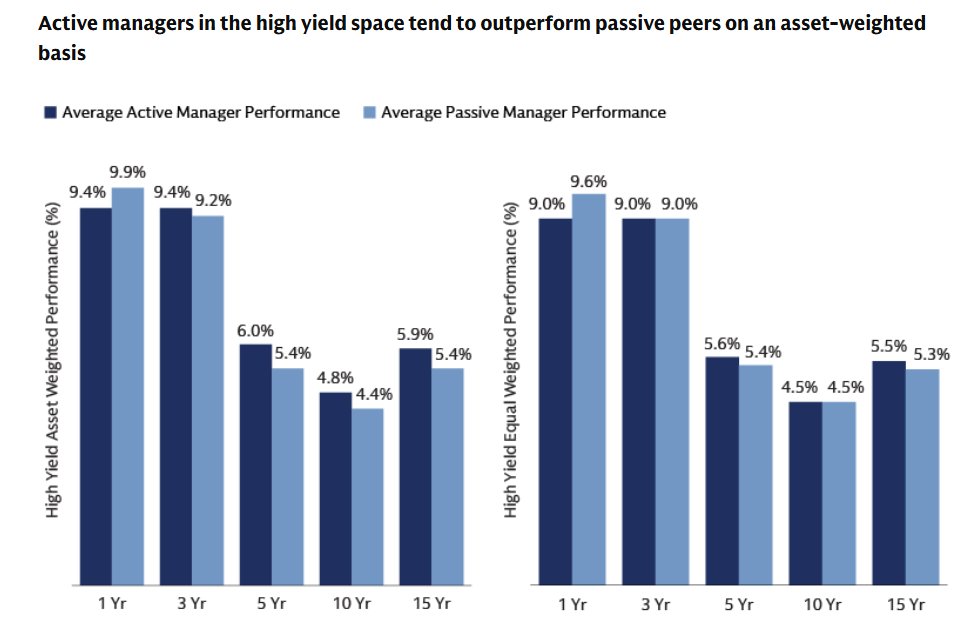
Active high-yield managers analyze balance sheets, cash-flow durability, industry dynamics, and management behavior to avoid issuers with deteriorating fundamentals. This approach boosts returns effectively. Over 15 years, active junk bond managers outperformed passive benchmarks annually by 5.9% versus 5.4%. 1
This Goldman Sachs chart highlights the additional return potential that active managers have delivered over passive benchmarks in the asset class.
Source: Goldman Sachs
How ETFs Improve the Active High-Yield Experience
Active management and security selection suit high-yield bonds. Goldman Sachs says active strategies can further improve performance via the ETF structure, which adds efficiency, liquidity, and transparency—qualities not typically linked to junk bonds.
ETFs provide liquidity to the illiquid high-yield market. Traditionally, investors used mutual funds for active high-yield strategies, which trade once daily and face redemption pressure in stressed markets. Active high-yield ETFs trade intraday like stocks, enabling investors to adjust exposure quickly amid changing conditions. This flexibility proves valuable when credit spreads widen rapidly and sentiment shifts abruptly.
Goldman Sachs argues that the ETF structure mitigates trading illiquidity and volatility during stress. Only a small fraction of high-yield debt trades daily, posing problems in turbulent times. ETFs use in-kind creation and redemption, passing bonds to participants. This reduces forced selling, dampens NAV volatility, and preserves portfolio integrity.
Active ETFs offer improved transparency. While some hide holdings, most disclose them frequently, enabling investors to track sector exposures, credit quality, and duration in real-time. In complex high-yield bonds, this visibility aids risk management and portfolio alignment—unlike mutual funds’ quarterly snapshots. Goldman notes defaults cluster in select sectors, like real estate, amid interest rate spikes.
Additionally, tax efficiency and low costs benefit investors.
Using Active High-Yield ETFs in a Portfolio
High-yield bonds fill multiple roles in diversified portfolios based on investors’ goals and risk tolerance, making them essential. Investors should choose active ETFs for this exposure. The benefits and extra alpha justify it across several dimensions.
The active ETF boom offers investors many new options in junk bonds, spanning durations and credit levels.
Active High-Yield Bond ETFs
These funds provide active access to high-yield bonds, sorted by YTD total return from 1.3% to 4.7%. Expense ratios range from 0.22% to 1.02%, AUMs from $50M to $5.63B, and yields from 5.7% to 8.6%.
| Ticker | Name | AUM | YTD Total Ret (%) | Yield (%) | Exp Ratio | Security Type | Actively Managed? |
|---|---|---|---|---|---|---|---|
| FLHY | Franklin High Yield Corporate ETF | $268M | 4.7% | 5.7% | 0.40% | ETF | Yes |
| YLD | Principal Active High Yield ETF | $160M | 4.7% | 7.2% | 0.39% | ETF | Yes |
| HYBL | SPDR Blackstone High Income ETF | $136M | 4.4% | 8.2% | 0.70% | ETF | Yes |
| THYF | T. Rowe Price U.S. High Yield ETF | $50M | 4.1% | 7.5% | 0.56% | ETF | Yes |
| SRLN | SPDR Blackstone Senior Loan ETF | $5.63B | 3.8% | 8.6% | 0.70% | ETF | Yes |
| FTSL | First Trust Senior Loan Fund | $2.27B | 3.8% | 7.5% | 0.87% | ETF | Yes |
| BKHY | BNY Mellon High Yield Beta ETF | $292M | 3.4% | 6.9% | 0.22% | ETF | Yes |
| PHYL | PGIM Active High Yield Bond ETF | $124M | 3.4% | 8.2% | 0.39% | ETF | Yes |
| HYFI | AB High Yield ETF | $123M | 3.4% | 6.7% | 0.40% | ETF | Yes |
| HYLS | First Trust Tactical High Yield ETF | $1.43B | 1.3% | 6.4% | 1.02% | ETF | Yes |
High-yield bond investing requires skill, discipline, and flexibility. Active management has long shown its value in navigating junk bond complexities, from avoiding defaults to capitalizing on credit cycle opportunities. Active ETFs further build on this by combining seasoned credit managers’ expertise with an ETF’s liquidity, transparency, and efficiency.
Bottom Line
For investors seeking income, diversification, and enhanced risk-adjusted returns, active high-yield ETFs represent a powerful evolution in fixed-income investing—one that aligns active credit selection with modern portfolio construction demands.
1 Goldman Sachs (November 2025). How Active ETFs May Enhance High Yield Bond Investing