Exchange-traded funds have been one of the most powerful forces reshaping modern investing, and the start of 2026 showed that momentum remains firmly intact. After a record-setting year for ETF flows in 2025, investors entered the new year with strong demand for both passive and actively managed strategies. However, one of the most striking developments has been the continued growth of active ETFs.
January’s flow data illustrates just how rapidly this segment is expanding.
Investors poured massive amounts of capital into ETFs at the start of the year, with actively managed strategies capturing a substantial share of those flows. The trend reflects a broader shift in how investors think about portfolio construction. Rather than choosing between active and passive investing, many investors are now embracing active ETFs as a flexible, efficient vehicle for implementing investment strategies.
The Data Behind Active ETF Growth
Active ETFs have quickly grown from a niche asset class into a behemoth, and the numbers make that growth clear. In 2025, active ETFs gathered roughly $475 billion in inflows, representing about one-third of all new ETF assets for the year. Nearly 1,000 new funds came to market during the year, demonstrating the rapid expansion of the category. 1
That strong momentum carried directly into the new year. January 2026 marked one of the strongest starts for the ETF industry on record, with investors adding roughly $165 billion to U.S.-listed ETFs—the largest January inflow ever and more than the combined inflows of the previous three Januarys.
Active ETFs contributed heavily to that growth.
Within that record total, active ETFs captured a particularly large share. According to data provided by State Street Investment Management, active ETF strategies attracted approximately $65 billion in inflows during January, accounting for nearly 40% of all ETF flows for the month.
These figures highlight a dramatic shift in investor preferences. Just a decade ago, active ETFs represented a niche corner of the market, but today they are becoming a major component of ETF flows and portfolio allocations.
Why Investors Are Turning to Active ETFs
Several factors explain why active ETFs have become a preferred vehicle for investors. At a high level, the structure combines the strengths of active management with the benefits of the ETF wrapper.
First, active ETFs provide access to professional portfolio management. Instead of simply replicating an index, active managers can conduct research, select securities, and adjust portfolio exposures based on evolving market conditions—flexibility that can be particularly valuable during periods of economic uncertainty or heightened volatility.
Second, the ETF structure offers significant advantages over traditional mutual funds. ETFs trade throughout the day on exchanges, giving investors more flexibility than mutual funds, which typically execute transactions only once per day at the closing net asset value.
The ETF creation and redemption mechanism also delivers tax efficiency, allowing fund managers to manage capital gains more effectively and often resulting in fewer taxable distributions compared with mutual funds.
Cost efficiency is another advantage. Although active ETFs often carry slightly higher expense ratios than passive index funds, they typically remain cheaper than traditional actively managed mutual funds, making them an appealing middle ground for cost-conscious investors who still want active management.
Finally, the expanding variety of strategies available through active ETFs has dramatically broadened their appeal. Investors can now access active approaches across equities, fixed-income, income strategies, multi-asset portfolios, and alternatives, allowing active ETFs to serve as both core portfolio components and targeted tactical allocations.
Structural Shifts in Portfolio Construction
The rapid growth of active ETF flows reflects a deeper transformation in portfolio construction.
Active ETFs allow investors to add targeted strategies that seek to enhance returns, manage risk, or pursue specific outcomes—such as income generation, tactical asset allocation, credit selection in fixed-income, or factor-based equity strategies.
Advisors and institutional investors have been particularly quick to adopt this approach, and many model portfolios now incorporate both passive index funds and active ETFs to capture different sources of return.
Looking ahead, the growth of active ETFs appears assured. According to research from Cerulli Associates, most advisors and gatekeepers are directing new money toward active ETFs in the years ahead, as the chart below illustrates.
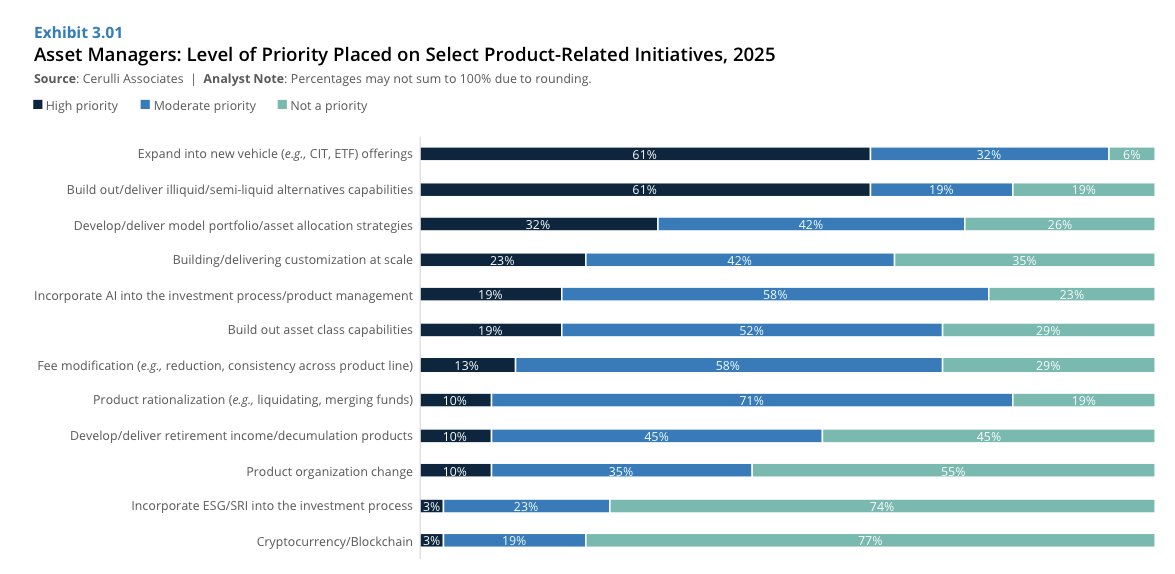
_Source: Cerulli _
Popular Active ETFs
These active ETFs—sorted by YTD total returns (3.1% to 18.4%)—have expense ratios from 0.17% to 0.70%, AUM from $500 million to $42 billion, and yields from 0% to 9.7%.
| Ticker | Name | AUM | YTD Total Ret (%) | Yield (%) | Exp Ratio | Security Type | Actively Managed? |
|---|---|---|---|---|---|---|---|
| CGGR | Capital Group Growth ETF | $16.7B | 18.4% | 0.4% | 0.39% | ETF | Yes |
| FBCG | Fidelity Blue Chip Growth ETF | $4.9B | 15.5% | 0.5% | 0.60% | ETF | Yes |
| TCHP | T. Rowe Price Blue Chip Growth ETF | $1.6B | 15.1% | 0% | 0.57% | ETF | Yes |
| JEPQ | J.P. Morgan Nasdaq Equity Premium Income ETF | $30.9B | 11.4% | 9.7% | 0.35% | ETF | Yes |
| DFAC | Dimensional U.S. Core Equity 2 ETF | $38.4B | 11.3% | 0.8% | 0.17% | ETF | Yes |
| DFUV | Dimensional U.S. Marketwide Value ETF | $12.3B | 9.2% | 1.5% | 0.21% | ETF | Yes |
| FBND | Fidelity Total Bond ETF | $21.1B | 7.2% | 4.9% | 0.36% | ETF | Yes |
| HYBL | SPDR Blackstone High Income ETF | $511M | 5.6% | 8.2% | 0.70% | ETF | Yes |
| JEPI | JPMorgan Equity Premium Income ETF | $41.3B | 5.4% | 7.4% | 0.35% | ETF | Yes |
| JPST | JPMorgan Ultra Short Income ETF | $34.1B | 4.4% | 5.2% | 0.18% | ETF | Yes |
| AVUV | Avantis U.S. Small-Cap Value ETF | $18.6B | 4.1% | 1.4% | 0.25% | ETF | Yes |
| MINT | PIMCO Enhanced Short Maturity Active ETF | $14B | 4.1% | 5.3% | 0.35% | ETF | Yes |
| DFAT | Dimensional U.S. Targeted Value ETF | $11.6B | 3.1% | 0.8% | 0.28% | ETF | Yes |
The start of 2026 served as a powerful reminder of the momentum behind active ETFs. Record ETF inflows in January, combined with massive inflows into active strategies, highlight how rapidly the investment landscape is evolving.
Investors are drawn to the flexibility, transparency, and cost efficiency that active ETFs offer. As the industry innovates and expands, active ETFs are likely to play an even larger role in portfolios—bridging the gap between traditional active management and the structural advantages of the ETF wrapper.
Bottom Line
The surge in active ETF flows at the start of the year underscores a major shift in how investors are building portfolios. With record inflows in both 2025 and January 2026, active ETFs are no longer a niche product but a rapidly growing segment of the ETF universe.
1 Morningstar (February 2026). Active ETF Launches and Closures: 2025 in Review