Today’s market is captivated by artificial intelligence (AI), disruptive innovation, and high-growth technology stocks. Headlines are filled with these themes, and investors have moved billions of dollars into stocks and bonds tied to A.I. and tech. As a result, dividend-paying companies rarely dominate headlines these days, lacking the excitement of explosive earnings growth or the narrative-driven momentum that has fueled recent market rallies.
Yet this perception misses the bigger picture. Dividend investing, particularly when focused on growth rather than yield alone, has quietly been one of the most reliable and resilient strategies over time.
In today’s environment—marked by higher interest rates, persistent inflation, and increased market uncertainty—the strengths of dividend investing are becoming more valuable. Investors are recognizing that generating steady income while participating in equity growth is not just appealing but essential. This is where active dividend growth investing stands out as a powerful approach.
Dividend Investing Still Matters
Dividend investing may feel like an out-of-touch relic in today’s fast-paced market. The rise of technology stocks, bitcoin, round-the-clock trading, and other “fast” themes has led many investors to abandon dividends in pursuit of explosive returns. This attitude may be misguided and could be doing their portfolios more harm than good.
At its core, dividend growth investing is about more than income. It is about building a portfolio that generates returns in multiple ways, providing both stability and growth over time—a fact that is more important than ever today.
Dividend-paying companies also tend to be more established and financially disciplined. Firms that consistently pay and grow dividends often have strong balance sheets, stable earnings, and a clear commitment to returning capital to shareholders.
This underscores one of the most important benefits of dividends: the reliability of cash flow.
Unlike capital gains, which depend on market conditions, dividends provide a tangible return regardless of short-term price movements. This steady income stream can be particularly valuable during periods of market volatility, offering stability when prices fluctuate.
These characteristics can translate into lower volatility than non-dividend-paying stocks, making them attractive to investors seeking a smoother ride through market cycles.
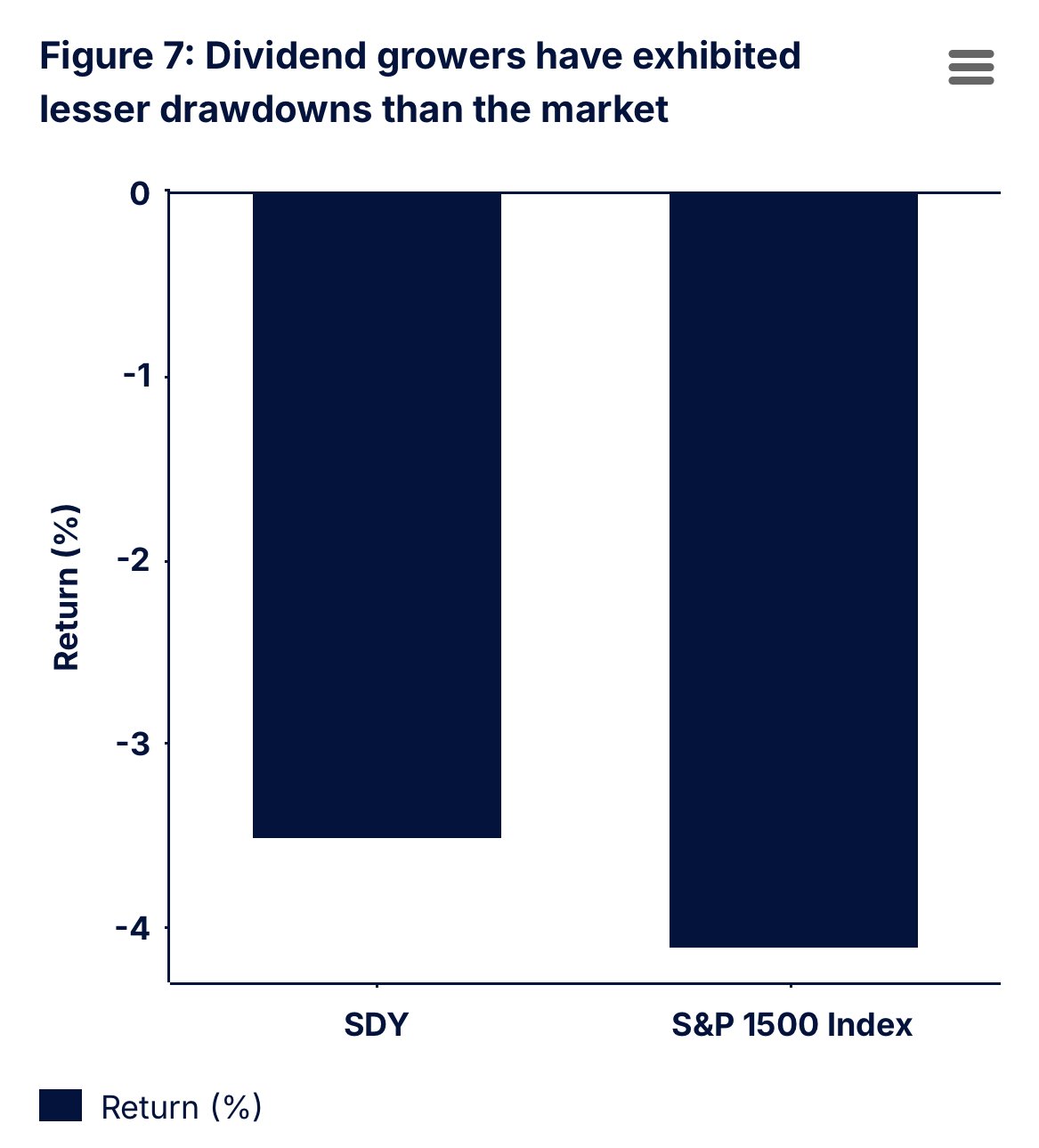
That stability plays out in actual drawdown protection. Looking at the S&P High Yield Dividend Aristocrats Index—as tracked by the State Street SPDR S&P Dividend ETF—dividend growers have outperformed the broader market during periods of stress. This chart from State Street highlights the index’s lower average drawdown versus the S&P 1500.
Source: State Street
Dividend growth firms also help address another key portfolio challenge: inflation. As the cost of living rises, income from fixed sources loses purchasing power. Companies that increase their dividends over time can help offset this effect. According to financial data aggregator Multpl, the S&P 500 has grown its payout by 5.99% per year over the last 30 years, outpacing long-term CPI changes. 1
Dividends have also historically contributed a significant portion of total equity returns. Reinvested dividends compound over time, enhancing long-term performance—an effect that is often overlooked but remains one of the most powerful drivers of wealth accumulation.
The Role of Active Management in Dividend Growth Investing
With these advantages in mind, dividend growth investing is a compelling strategy for many investors, offering steady long-term growth with reduced return volatility. However, its success depends heavily on security selection.
Passive dividend strategies—such as those tracking dividend-focused indices—often rely on backward-looking metrics. They may include companies based on historical dividend yields or past performance without fully accounting for future growth potential or underlying risks, and can inadvertently overweight sectors or companies that look attractive on paper but face challenges ahead.
This is where active management plays a critical role.
Active managers take a forward-looking approach, analyzing factors, such as earnings growth, cash flow sustainability, balance sheet strength, and competitive positioning. This allows them to identify companies that are not only paying dividends today but are well-positioned to grow those dividends in the future.
Active management also provides flexibility. Managers can adjust portfolios in response to changing market conditions, reallocating capital to sectors or companies with the most attractive opportunities—shifting toward industries benefiting from economic growth or away from those facing structural headwinds. This flexibility supports risk management, as active managers can avoid companies with unsustainable payout ratios or deteriorating fundamentals, reducing the likelihood of dividend cuts.
In a market defined by rapid change and increasing complexity, this ability to adapt is invaluable. Active management transforms dividend investing from a static strategy into a dynamic one, capable of capturing opportunities and managing risks in real time.
It turns out that being active with dividends works. Morningstar’s latest active/passive barometer shows that active dividend managers hold a slight edge over their passive counterparts.
Active ETFs Are Transforming Dividend Growth Investing
Active management is receiving an additional boost. The rise of active ETFs has made it easier than ever for investors to access active dividend growth strategies.
Active ETFs combine the benefits of traditional active management with the structural advantages of ETFs, offering daily liquidity, transparency, and tax efficiency while retaining the expertise and flexibility of professional portfolio management. The creation-redemption mechanism is a notable win for investors, allowing ETFs to pass capital gains through in-kind transactions. When a fund manager exits a position, investors bear none of the resulting tax consequences. Short-term capital gains can be particularly detrimental to portfolios, diminishing the tax advantages of dividend investing.
By using an active ETF for their dividend growth strategy, investors can potentially enhance returns further and build a portfolio capable of performing across different market environments.
Numerous domestic and international active ETFs focused on dividend growth strategies are available. By selecting one of these funds, investors can gain core income and a return boost while reducing overall volatility and drawdown potential.
Active Dividend ETFs
These ETFs were selected based on their exposure to dividend stocks with an active touch. The list is sorted by YTD total return, which ranges from 6% to 20%. Expense ratios fall between 0.33% and 1.97%, assets under management range from $8M to $7B, and current yields range from 1.5% to 12.6%.
| Ticker | Name | AUM | YTD Total Ret (%) | Yield (%) | Exp Ratio | Security Type | Actively Managed? |
|---|---|---|---|---|---|---|---|
| HIDV | AB U.S. High Dividend ETF | $12.4M | 19.7% | 2% | 0.45% | ETF | Yes |
| CGDV | Capital Group Dividend Value ETF | $7.04B | 18.6% | 1.5% | 0.33% | ETF | Yes |
| JHDV | John Hancock U.S. High Dividend ETF | $8.2M | 16.6% | 2.5% | 1.97% | ETF | Yes |
| TEQI | T. Rowe Price Equity Income ETF | $158M | 13% | 1.6% | 0.54% | ETF | Yes |
| JHID | John Hancock International High Dividend ETF | $8M | 6% | 12.6% | 1.32% | ETF | Yes |
Active International Dividend ETFs
These ETFs were selected based on their exposure to international dividend stocks with an active management approach. Sorted by YTD total return, they range from 6% to 22%, with expense ratios between 0.32% and 2.81%, assets under management of $3M to $716M, and current yields between 2.3% and 12.6%.
| Ticker | Name | AUM | YTD Total Ret (%) | Yield (%) | Exp Ratio | Security Type | Actively Managed? |
|---|---|---|---|---|---|---|---|
| INEQ | Columbia International Equity Income ETF | $7.85M | 22.2% | 5% | 0.46% | Yes | |
| IDVO | Amplify CWP International Enhanced Dividend Income ETF | $178M | 17.4% | 6% | 0.66% | ETF | Yes |
| ADVE | Matthews Asia Dividend Active ETF | $3.2M | 12.2% | 2.3% | 0.79% | ETF | Yes |
| DGRE | WisdomTree Emerging Markets Quality Dividend Growth Fund | $128M | 11.3% | 2.5% | 0.32% | ETF | Yes |
| BIDD | iShares International Dividend Active ETF | $716M | 11.1% | 4.5% | 0.61% | ETF | Yes |
| JHID | John Hancock International High Dividend ETF | $8M | 6% | 12.6% | 2.81% | ETF | Yes |
Dividend investing may not capture the same attention as high-growth technology stocks, but its value becomes increasingly clear over time. In a market defined by uncertainty and rapid change, the ability to generate consistent income while participating in long-term growth is a powerful advantage.
Active dividend growth investing takes this concept further. By focusing on companies with strong fundamentals and the capacity to increase payouts, and by leveraging active managers’ expertise, investors can enhance both income and total return potential.
Bottom Line
Active dividend growth investing offers a compelling combination of income, stability, and long-term growth, making it an attractive strategy in today’s uncertain market. Paired with active management—especially through efficient ETF structures—this approach enables better security selection, risk management, and adaptability, ultimately building a more balanced and resilient portfolio over time.
1 Multpl (April 2026). S&P 500 Dividend Growth