Taxes are one of the few certainties in investing—and one of the most persistent drags on long-term wealth creation. No matter how strong market returns may be, taxes often claim a portion of those gains through capital gains, dividends, and distributions that investors may not anticipate. Active management offers potential for superior long-term performance, but it can also increase taxable events through higher turnover and realized gains.
Because of this, tax awareness is not just a nice-to-have—it’s a critical component of long-term investment success.
In this environment, active exchange-traded funds (ETFs) have emerged as a compelling solution that blends professional management with structural features for tax-aware investing. Taxes remain unavoidable for most investors, but active ETFs can mitigate their impact on many portfolios.
Taxes Matter for Investors
For many investors, returns take center stage, but smart tax management deserves equal focus. Taxes rank among the most persistent drags on investment performance.
Every time an investor realizes a gain—whether by selling individual securities or receiving taxable distributions from a fund—federal, state, or local taxes claim a portion of it. Though these taxes may seem like one-time events, they compound against the investor’s total return over time. Analysts call this phenomenon tax drag. Even strong gross returns disappoint after taxes, especially for high-bracket investors in taxable accounts.
Active management can compound this tax drag further.
Active management holds vast potential to generate higher alpha in portfolios. However, it—where portfolio managers buy and sell securities to outperform a benchmark—can worsen tax drag. Every trade risks crystallizing taxable gains if securities sell above cost basis. Thus, active management produces significant capital gains distributions passed to shareholders, even if their investment value has not risen, as in mutual funds.
Research shows that ignoring tax implications erodes active management’s net benefit, especially in taxable accounts. Natixis reports S&P 500 tax drag at 0.3% to 0.4% annualized. Average tax drag for active large-cap core mutual funds exceed 1%. For high-tax-bracket investors, active management tax drag can halve desired allocations to active strategies versus passive ones. Investors thus forgo much of active management’s benefit and might as well use passive strategies. 1
Active ETFs Change the Game
Hope remains for portfolios seeking alpha while reducing tax drag. Active ETFs tackle the issue directly, with the ETF structure playing a pivotal role.
The ETF wrapper’s key innovation is its creation-redemption mechanism. It works this way: when redeeming ETF shares, the authorized participant—typically a broker-dealer or institutional investor—exchanges them for underlying securities in kind, not cash. The ETF thus avoids selling holdings on the open market. With no securities sold, the fund realizes no taxable gain. Investors holding ETF shares thus avoid capital gains taxes.
This mechanism significantly reduces capital gains distributions compared to other active vehicles like mutual funds. Mutual funds often sell securities for redemptions and distribute taxable gains, but ETFs handle flows more efficiently.
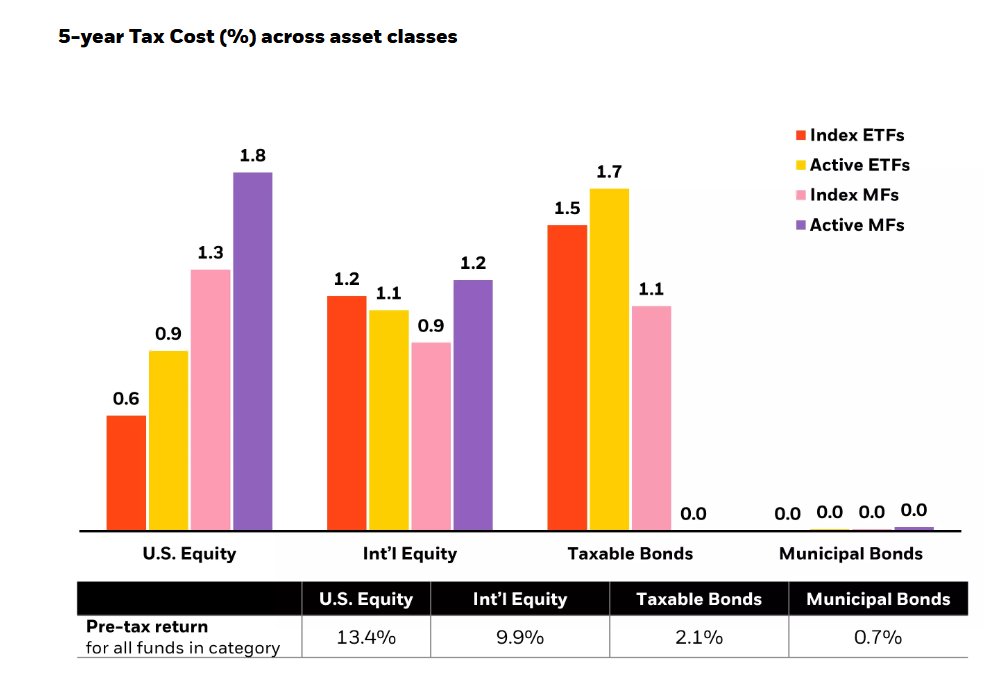
This feature delivers real impact. Multiyear tax efficiency comparisons show active ETFs distribute far fewer capital gains than active mutual funds—often much less than similar-strategy mutual funds. Recent data illustrates only a small fraction of active ETFs distribute capital gains in a given year, while a large share of active mutual funds do. This BlackRock chart highlights active ETFs’ lower tax costs and drag across asset classes.
Source: BlackRock.
Investors in active ETFs thus retain more alpha for greater long-term wealth. Tax drag persists but lessens.
Active ETFs also enable tax-aware strategies like tax-loss harvesting. This technique sells declined securities to realize losses, offsetting gains elsewhere and reducing tax liability. ETF investors control gain or loss realization, so they can book losses in one fund while buying another. Differences in active ETFs and strategies often let investors sidestep the wash-sale rule for similar investments.
Goldman Sachs notes this combination boosts long-term wealth. Active ETFs’ structure plus tax-loss harvesting yields 0.48 basis points of excess return after taxes for higher-bracket investors. 2
Active ETFs and Tax Awareness
Growing research on tax-aware investing reveals that tax efficiency and active management need not conflict. Thoughtful implementation makes them complementary. Active management generates excess returns by spotting mispriced securities, managing risk, and adapting to markets. Without addressing turnover’s tax costs, benefits shrink—especially for high-tax-bracket investors.
Pairing active strategies with ETF structures gives investors access to professional management in a tax-efficient wrapper that harnesses exchange trading, in-kind redemptions, and tax-loss harvesting. Although active ETFs do not perfectly hedge all taxable events, they reduce the frequency and magnitude of taxable distributions that historically cut after-tax returns in active mutual funds.
Investors focused on after-tax wealth accumulation—especially in taxable accounts or higher tax brackets—find this advantage meaningful over long horizons. When building portfolios, considering post-tax outcomes alongside pre-tax returns enhances real wealth accumulation and lets investors keep more of what they earn.
Popular Active ETFs
These ETFs, sorted by YTD total returns (3.1% to 18.4%), have expense ratios of 0.17% to 0.70% and assets under management from $500 million to $42 billion. They currently yield 0% to 9.7%.
| Ticker | Name | AUM | YTD Total Ret (%) | Yield (%) | Exp Ratio | Security Type | Actively Managed? |
|---|---|---|---|---|---|---|---|
| CGGR | Capital Group Growth ETF | $16.7B | 18.4% | 0.4% | 0.39% | ETF | Yes |
| FBCG | Fidelity Blue Chip Growth ETF | $4.9B | 15.5% | 0.5% | 0.60% | ETF | Yes |
| TCHP | T. Rowe Price Blue Chip Growth ETF | $1.6B | 15.1% | 0% | 0.57% | ETF | Yes |
| DFAC | Dimensional U.S. Core Equity 2 ETF | $38.4B | 11.3% | 0.8% | 0.17% | ETF | Yes |
| JEPQ | J.P. Morgan Nasdaq Equity Premium Income ETF | $30.9B | 11.4% | 9.7% | 0.35% | ETF | Yes |
| DFUV | Dimensional U.S. Marketwide Value ETF | $12.3B | 9.2% | 1.5% | 0.21% | ETF | Yes |
| FBND | Fidelity Total Bond ETF | $21.1B | 7.2% | 4.9% | 0.36% | ETF | Yes |
| HYBL | SPDR Blackstone High Income ETF | $511M | 5.6% | 8.2% | 0.70% | ETF | Yes |
| JEPI | JPMorgan Equity Premium Income ETF | $41.3B | 5.4% | 7.4% | 0.35% | ETF | Yes |
| JPST | JPMorgan Ultra Short Income ETF | $34.1B | 4.4% | 5.2% | 0.18% | ETF | Yes |
| AVUV | Avantis U.S. Small-Cap Value ETF | $18.6B | 4.1% | 1.4% | 0.25% | ETF | Yes |
| MINT | PIMCO Enhanced Short Maturity Active ETF | $14B | 4.1% | 5.3% | 0.35% | ETF | Yes |
| DFAT | Dimensional U.S. Targeted Value ETF | $11.6B | 3.1% | 0.8% | 0.28% | ETF | Yes |
Taxes are inevitable, but need not silently erode returns. Active ETFs let investors pursue professional, flexible strategies while mitigating tax pitfalls that plagued active mutual funds. The ETF creation-redemption process and tax-loss harvesting provide meaningful tax efficiency for long-term, tax-aware investing.
Bottom Line
In an era when active management and tax awareness matter most, active ETFs offer a powerful tool. Used thoughtfully, they balance return pursuit with taxable investing realities.
1 Natixis (January 2026). Tax drag: What it is and ways to potentially reduce it
2 Goldman Sachs (December 2025). A Tax-Aware Approach to Active Management