For much of their history, exchange-traded funds (ETFs) offered broad market exposure, low costs, and mechanical index tracking synonymous with passive investing. Active management resided primarily in mutual funds and separately managed accounts. That divide no longer exists.
Over the past several years, active ETFs have proliferated in number, variety, and sophistication, transforming the way investors construct their portfolios.
What was once a narrow product category has evolved into a comprehensive ecosystem of strategies encompassing equities, fixed-income, alternatives, and outcome-oriented solutions. Today, investors can assemble entire portfolios using only active ETFs, combining flexibility, transparency, and professional management impossible a decade ago.
The Rapid Growth of Active ETFs
Active ETF growth has proven extraordinary, evolving from a niche experiment into one of the asset management industry’s fastest-growing segments. Active ETFs now represent a significant share of annual launches, with assets under management expanding at a pace rivaling or exceeding passive ETFs.
Hundreds of active ETFs have launched recently, drawing dozens of issuers into the market. Established asset managers, boutique firms, and traditional mutual fund giants have embraced the structure. Firms once resistant to ETFs have made active ETFs central to growth strategies, launching funds across asset classes.
Several factors drive this expansion. Investors seek choices beyond low costs, including strategies that adapt to shifting markets, manage risk dynamically, and pursue outcomes exceeding index matching. Advisors need tools that integrate into their models, provide daily liquidity, and exceed the tax efficiency of mutual funds. Active ETFs meet these demands.
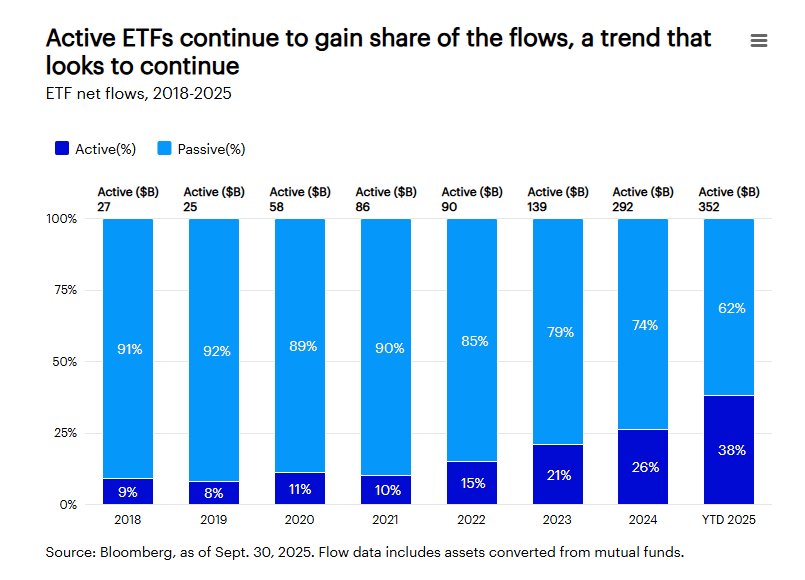
Fund flows support that narrative. This chart from Invesco illustrates active ETFs continuing to gain market share from passive ETFs.
Source: Invesco
Beyond Stock and Bond Picking
Most importantly, this growth spans multiple styles and asset classes. Active ETFs now cover fundamental stock selection, tactical asset allocation, credit strategies, and options-based income, expanding the toolkit for portfolio construction.
Early active ETFs mimicked mutual fund strategies through equity stock picking and bond security selection. While those remain important, the active ETF universe has advanced beyond simple security selection.
Today’s active ETFs focus on portfolio outcomes rather than benchmarks. Many target specific objectives—income generation, volatility reduction, downside protection, or risk-adjusted return optimization—rather than index outperformance. This shift aligns with how investors view portfolios and goals.
Options-based and enhanced ETFs mark a key development. These funds use options overlays to reshape returns, which individual investors historically struggled to implement efficiently. Covered call ETFs generate income via sold calls. Using options, buffer and defined-outcome ETFs provide downside protection with capped upside potential. Others employ put spreads, collars, or dynamic positioning to manage volatility.
These ETFs offer more than traditional active management; they provide structural innovations. Investors gain access to sophisticated risk-management techniques in a transparent, liquid wrapper without trading options directly or managing complex strategies themselves.
Active ETFs have expanded into multi-asset and global allocation strategies. Rather than combining multiple single-asset funds, these ETFs dynamically allocate across equities, fixed-income, and sometimes alternatives in one vehicle. This mirrors the greater importance of asset allocation over individual security selection.
Active ETFs have flourished in fixed-income due to the inefficiencies present in bond markets. Credit selection, duration management, and sector rotation add value, while the ETF structure enhances liquidity, transparency, and tax efficiency over traditional bond-focused mutual funds.
Active ETFs have increased investor choice through diverse issuers. Large global asset managers provide scale, distribution, and institutional research. Boutiques offer specialization, creativity, and niche expertise. Together, they foster competition that rewards innovation.
This competition accelerates product development. Investors now access strategies unavailable in ETF form just years ago, including thematic active strategies, factor-aware portfolios with human oversight, real-time adaptive quantitative models, and multi-source income strategies.
What This Means for the Future of Investing
Investors now have abundant choices and tools to build portfolios once limited to institutional and high-net-worth clients. As markets grow more complex with less predictable correlations, they demand adaptive tools. Active ETFs meet this need by pairing professional management with an ETF’s structural benefits, offering control without sacrificing expertise or adding unnecessary complexity.
Looking ahead, innovation in active ETFs is unlikely to slow. Issuers continue to experiment with new strategies, asset classes, and risk frameworks, giving investors more options to fine-tune portfolios. What once required bespoke solutions or institutional access now appears in a single, transparent vehicle.
The most important implication is that investors can now build fully active portfolios using ETFs alone. Active management once required mutual funds, ETFs, and separate accounts, but today’s broad active ETF lineup covers every significant portfolio sleeve affordably.
Popular Active ETFs
These active ETFs are sorted by YTD total returns, ranging from 5.1% to 17.4%. Expense ratios range from 0.17% to 0.36%, assets under management range from $11 billion to $42 billion, and current yields range from 0.8% to 11.2%.
| Ticker | Name | AUM | YTD Total Ret (%) | Yield (%) | Exp Ratio | Security Type | Actively Managed? |
|---|---|---|---|---|---|---|---|
| JEPQ | J.P. Morgan Nasdaq Equity Premium Income ETF | $32B | 17.4% | 11.2% | 0.35% | ETF | Yes |
| DFAC | Dimensional U.S. Core Equity 2 ETF | $40B | 17.2% | 0.8% | 0.17% | ETF | Yes |
| DFUV | Dimensional U.S. Marketwide Value ETF | $12.6B | 17.1% | 1.5% | 0.21% | ETF | Yes |
| DFAT | Dimensional U.S. Targeted Value ETF | $11.8B | 10.4% | 1.6% | 0.28% | ETF | Yes |
| JEPI | JPMorgan Equity Premium Income ETF | $41.5B | 9.5% | 7.7% | 0.35% | ETF | Yes |
| AVUV | Avantis U.S. Small-Cap Value ETF | $19.4B | 9.2% | 1.4% | 0.25% | ETF | Yes |
| FBND | Fidelity Total Bond ETF | $22.9B | 7.8% | 4.4% | 0.36% | ETF | Yes |
| JPST | JPMorgan Ultra Short Income ETF | $35.3B | 5.4% | 4.2% | 0.18% | ETF | Yes |
| MINT | PIMCO Enhanced Short Maturity Active ETF | $14.5B | 5.1% | 4.4% | 0.36% | ETF | Yes |
Active ETFs have transformed from a niche category into a central force in modern portfolio construction. Rapid growth, expanding strategies, and structural advantages give investors unprecedented choice. No longer limited to stock and bond picking, they now encompass outcome-oriented strategies, options-based enhancements, and dynamic multi-asset solutions.
Bottom Line
Investors can now build fully active portfolios using only ETFs, combining flexibility, transparency, and professional management to align with real-world goals. Active ETFs have not only expanded the ETF universe but also redefined choice in investing.