Municipal bonds have quietly reemerged as one of the most compelling areas of the fixed-income market. For years, the asset class was viewed as a conservative corner of investing, favored mainly by high-net-worth investors seeking tax-efficient income. However, the dramatic shift in interest rates over the last several years has changed that narrative. Higher yields have restored municipal bonds as a serious income-generating asset class. For investors in higher tax brackets, the tax-equivalent yields can look especially attractive compared with taxable bonds.
While the case for the asset class looks increasingly compelling, the way investors access municipal bonds matters.
Unlike equities or more liquid segments of fixed-income, municipal bonds are not a market where passive investing always delivers the cleanest outcome. In fact, the structure of the muni market may make active management particularly valuable.
Passive Investing Doesn't Always Work for Munis
Passive investing has transformed portfolio construction across equities and broad bond markets. Today, investors can instantly build and own entire swaths of asset classes with only a handful of low-cost funds, making indexing the primary way many investors and advisors construct portfolios.
While matching the market works well for some asset classes, others can directly benefit from an active touch—and municipal bonds are one such segment.
The municipal market is highly fragmented, consisting of tens of thousands of individual securities issued by states, cities, counties, hospitals, airports, utilities, universities, and countless other public entities. Many of these bonds trade infrequently, liquidity can be uneven, and pricing is often less transparent than in other major bond markets.
That creates significant challenges for passive indexing.
One of the most fundamental flaws in passive bond investing is that benchmarks tend to allocate more heavily toward the largest issuers simply because they have issued the most debt. In equity markets, larger weights often reflect stronger businesses with higher market capitalizations, but in bond markets, they often mean only that an issuer has borrowed more.
That distinction can lead passive investors to strange outcomes. Instead of emphasizing the strongest opportunities, passive municipal strategies may overweight the most indebted issuers regardless of whether their risk-reward profile is compelling.
Index construction is also inherently backward-looking. Passive strategies own what has already been issued rather than positioning for emerging opportunities, changing credit conditions, or relative value shifts—a lack of flexibility that can be a meaningful disadvantage in a dynamic market like municipals.
Active's Three Big Muni Wins
Skilled managers can exploit this inefficiency to generate better returns, and it may not require exceptional skill to do so. According to AllianceBernstein, 98% of active muni strategies have meaningfully outperformed index approaches over rolling three-year periods, and 89% of active managers have beaten their muni benchmarks over rolling two-year periods. The firm also found that active strategies had better upside/downside capture ratios than passive muni indexes. 1
The question is how active managers generate more alpha and improve upon index returns. AllianceBernstein suggests the answer is threefold.
One of the clearest advantages active managers bring to the municipal market is the ability to position portfolios along the yield curve. Municipal yield curves shift constantly based on interest rate expectations, investor demand, issuance trends, and broader market conditions. Shorter maturities may offer compelling value with limited duration risk at certain times, while intermediate maturities may provide the most attractive combination of yield and price stability at others, and longer-dated bonds can become especially attractive when market dislocations occur.
Active managers can be far more intentional, picking up additional yield in longer parts of the curve and gaining valuable “roll” gains as the yield curve shifts.
Second, municipal bonds are often treated as a uniform asset class, but the reality is far more nuanced. A state general obligation bond backed by broad taxing authority is fundamentally different from a hospital revenue bond reliant on patient volumes and reimbursement dynamics.
Passive funds do not distinguish between improving and deteriorating fundamentals beyond index rules, but active managers do. This allows them to identify stronger credits while avoiding weaker ones, capturing higher yields while potentially reducing risk. The additional spreads available in muni credit over AAA munis can provide meaningful extra alpha, as highlighted in the chart below from the asset manager.
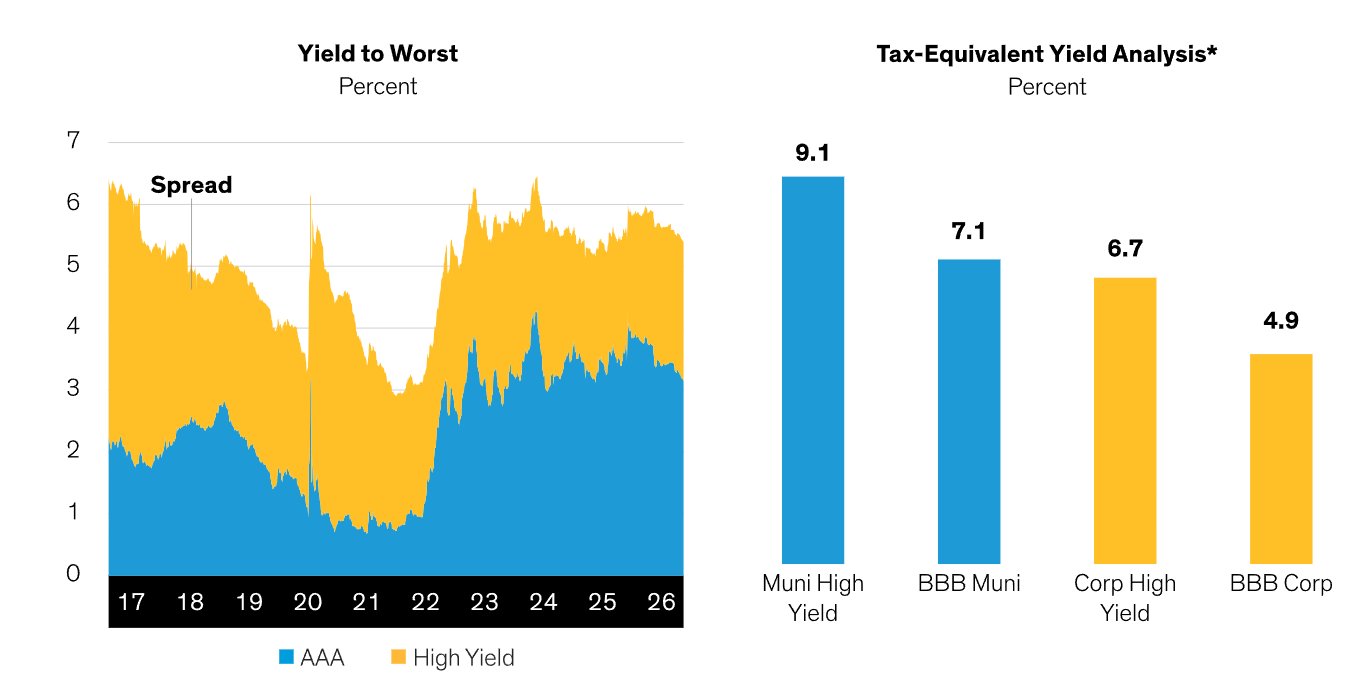
Source: AllianceBernstein
Finally, another important advantage of active management in municipal bonds is sector allocation flexibility.
Despite being grouped by indexes and many investors, the municipal market is not a single homogeneous pool of debt. It includes healthcare, transportation, education, utilities, housing, infrastructure, and general obligation bonds, among other categories, each responding differently to changing economic and market conditions. Active managers can rotate into or out of sectors and muni bond sub-types offering stronger relative value while reducing exposure where risks appear elevated. That flexibility can improve returns and reduce portfolio vulnerability, whereas passive strategies maintain benchmark exposure regardless of shifting fundamentals.
Investors Can Access the Opportunity
With these advantages and a history of outperformance, active management in the municipal bond sector makes a compelling case. By going active with their muni bond investments, investors have the potential to gain additional alpha and boost their returns.
Historically, investors seeking active municipal exposure often had to rely on traditional mutual funds or separately managed accounts. Today, actively managed municipal bond ETFs offer a more flexible solution, combining professional active management with the operational advantages of the ETF structure, including daily liquidity, transparency, and generally competitive costs.
For investors looking to benefit from active management, ETFs are a hard-to-beat package.
Active Municipal Bond ETFs
These ETFs were selected for their ability to provide low-cost, active exposure to the municipal bond market. Sorted by YTD total return, they range from -1.8% to 3.1%, carry expense ratios of 0.12% to 0.65%, and have assets under management of $418 million to $3.4 billion. Current yields range between 2.8% and 4%.
| Ticker | Name | AUM | YTD Total Ret (%) | Yield (%) | Exp Ratio | Security Type | Actively Managed? |
|---|---|---|---|---|---|---|---|
| SMMU | PIMCO Short Term Municipal Bond Active ETF | $890M | 3.1% | 2.9% | 0.35% | ETF | Yes |
| MEAR | iShares Short Maturity Municipal Bond Active ETF | $1.1B | 2.8% | 2.8% | 0.25% | ETF | Yes |
| IMNU | iShares Intermediate Muni Income Active ETF | $919M | 1.7% | 3.6% | 0.41% | ETF | Yes |
| HMOP | Hartford Municipal Opportunities ETF | $576M | 1.7% | 3.5% | 0.29% | ETF | Yes |
| CGMU | Capital Group Municipal Income ETF | $3.36B | 1.6% | 3.9% | 0.27% | ETF | Yes |
| MUNI | PIMCO Intermediate Municipal Bond Active ETF | $2B | 1.6% | 3.3% | 0.35% | ETF | Yes |
| MMIT | NYLI MacKay Muni Intermediate ETF | $1B | 1.6% | 3.6% | 0.47% | ETF | Yes |
| DFNM | Dimensional National Municipal Bond ETF | $1.57B | 1% | 3% | 0.19% | ETF | Yes |
| VCRM | Vanguard Core Tax-Exempt Bond ETF | $429M | 0.5% | 3.5% | 0.12% | ETF | Yes |
| SHYM | iShares High Yield Muni Income Active ETF | $370M | 0.3% | 4.4% | 0.41% | ETF | Yes |
| TAXF | American Century Diversified Municipal Bond ETF | $508M | -0.2% | 4% | 0.29% | ETF | Yes |
| FMB | First Trust Managed Municipal ETF | $2.04B | -0.3% | 3.5% | 0.65% | ETF | Yes |
| AVMU | Avantis Core Municipal fixed-income ETF | $148M | -1.8% | 3.9% | 0.15% | ETF | Yes |
Municipal bonds have become attractive thanks to higher yields, strong credit fundamentals, and tax-free income. Yet simply owning the broad municipal market may not be the most effective strategy.
The muni market is fragmented, complex, and structurally inefficient in ways that reward active decision-making. Passive strategies may overweight indebted issuers, miss shifting opportunities, and remain locked into static benchmark exposures. Active managers, by contrast, can position portfolios along the yield curve, identify stronger credits, and rotate dynamically between sectors as conditions evolve.
Bottom Line
The municipal bond market is fragmented, less efficient, and filled with diverse issuers and sectors. Active management can help investors capture more tax-free income through smarter yield curve positioning, credit selection, and sector rotation—and active ETFs are increasingly the vehicle of choice.
1 AllianceBernstein (March 2026). Three Reasons Why It Pays to Be Active as a Muni Investor