The active ETF market continued rapid expansion in 2025 as investors sought greater flexibility, tactical exposure, and diversified income opportunities. Wall Street obliged with a surge of new launches and mutual fund-to-ETF conversions that boosted assets and positioned active ETFs at center stage in many portfolios. Notably, investors have directed money to specific areas where trends are emerging in the ETF space.
Derivative income, large blend equity, ultra-short bond, and multi-sector bond sectors stood out among active ETF categories in 2025.
It’s no coincidence that these categories won significant investor money. They represent true innovation in the active ETF space, offering investors some of the best opportunities for additional alpha in their portfolios.
Active ETFs Continued Strong Growth in 2025
The active ETF universe in 2025 was built on several years of accelerating adoption. What once seemed a niche subset of the ETF market has become a mainstream choice for institutional and retail investors as well as financial advisors. Active ETFs offer daily liquidity and the structure of traditional ETFs, but with manager discretion to navigate shifting markets—a combination that resonated strongly in 2025’s mixed macro backdrop. Even as passive index products remain foundational for many core allocations, active ETFs increasingly became the vehicle of choice for investors seeking income generation, risk management, and adaptive positioning in both equity and fixed-income markets.
Fund flows confirmed this trend.
According to Morningstar data, active ETFs continued to outpace passive ETFs in both inflows and product launches in 2025. In fact, they pulled in $338 billion for the year—more than 2021, 2022, and 2023 combined. 1
Thus, active ETFs have become standard holdings in portfolios large and small.
Winners Emerge
This growth was not uniform. Certain categories stood out for the capital they attracted and the number of fund launches, driven by clear thematic and market drivers, plus investor demand. This chart from Morningstar illustrates that several categories led in launches and flows.
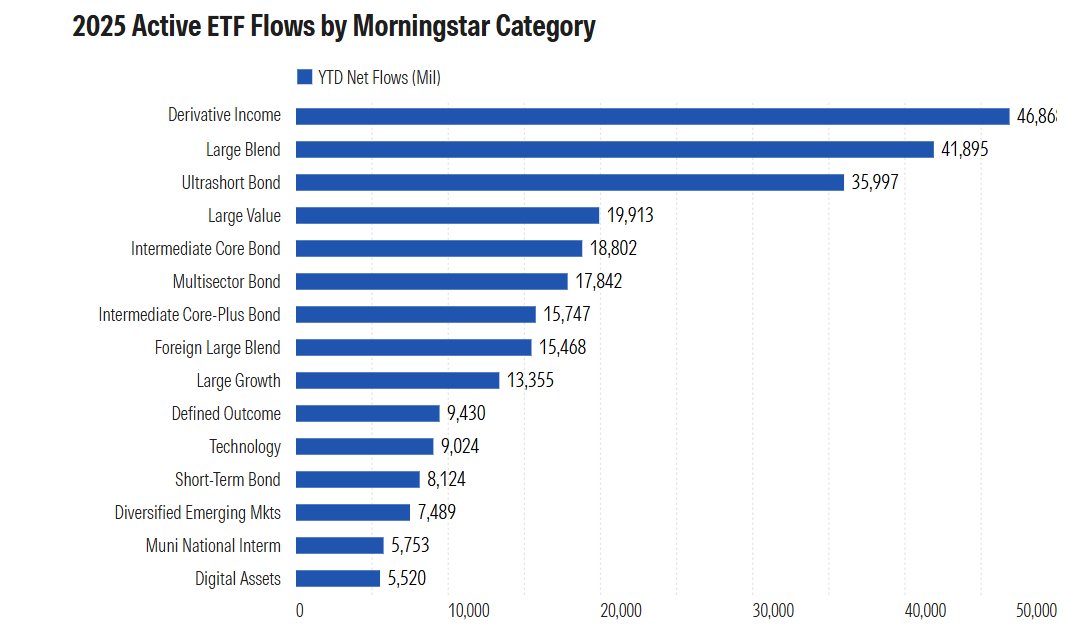
Source: Morningstar
Morningstar’s report illustrates investors favored derivative income, large blend equity, ultra-short bond, and multi-sector bond sectors in 2025. These categories captured most fund flows and interest. For example, State Street issued 11 active derivative income ETFs alone last year.
Each category offers unique features.
Derivative income ETFs use options, such as covered calls or put spreads, to reshape return profiles and generate enhanced income relative to traditional dividend or bond yields.
Large blend ETFs and their managers rotate between styles based on valuation, momentum, and risk considerations. As such, they look nothing like a broader equity index and can combine elements of both growth and value.
Ultra-short bond ETFs hold short-maturity bonds and similar instruments to provide income and stability in fixed-income portfolios.
Multi-sector bond ETFs invest across fixed-income sectors—including investment-grade, credit, high yield, emerging market debt, mortgage-backed securities, and other credit instruments—seeking income opportunities while managing sector risk.
What’s interesting is that although these fund categories appear different on the surface, they all seek to provide the same benefits deep down: risk reduction amid uncertainty.
It’s no secret that many risks and unknowns loom heading into the new year. Geopolitical concerns grow, inflation remains steadfast, interest rate policy changes rapidly, and equity valuations ride high. All these categories resonating with investors are designed for steady returns with built-in risk control.
For example, derivative income ETFs generate high income that softens drawdowns and provides significant cash flow in sideways markets. As interest rate expectations shifted and volatility persisted in core bond markets, many traditional fixed-income investors sought attractive yield while minimizing duration risk. Ultra-short bond ETFs do just that. Multi-sector bond ETFs allow investors to do the same on the credit side. Large blend funds suit uncertain equity markets where neither style dominates consistently. “Growth at a reasonable price” can be achieved.
These winning active ETF categories allow portfolios to confront uncertainty head-on, stay invested, and potentially come out ahead as the market works through its malaise. The best part? These funds and strategies were once reserved for institutional investors and high-net-worth families. Active ETF growth now lets average investors participate—and assures their growth.
How Investors Can Think About 2026
Heading into the new year and 2026, many of these categories still make sense for portfolios since uncertainty has grown, and portfolios need preparation. These active ETFs offer near-perfect solutions for reducing many risks facing investors in the new year. Although plenty of time remains and new trends will almost assuredly emerge, last year’s fund flow winners could still rise to the top and enter more portfolios this year.
Popular Active ETFs
These active ETFs, sorted by 1-year total returns from 4.7% to 20.6%, have expense ratios from 0.17% to 0.36%, assets under management from $12.8 billion to $43 billion, and yields from 0.9% to 9.6%.
| Ticker | Name | AUM | 1Y Total Ret (%) | Yield (%) | Exp Ratio | Security Type | Actively Managed? |
|---|---|---|---|---|---|---|---|
| AVUV | Avantis U.S. Small-Cap Value ETF | $22.2B | 20.6% | 1.3% | 0.25% | ETF | Yes |
| DFUV | Dimensional U.S. Marketwide Value ETF | $13.5B | 20.5% | 1.3% | 0.21% | ETF | Yes |
| DFAT | Dimensional U.S. Targeted Value ETF | $12.8B | 19.1% | 1.5% | 0.28% | ETF | Yes |
| DFAC | Dimensional U.S. Core Equity 2 ETF | $41.6B | 17.3% | 0.9% | 0.17% | ETF | Yes |
| JEPQ | JPMorgan Nasdaq Equity Premium Income ETF | $32B | 13.5% | 9.6% | 0.35% | ETF | Yes |
| JEPI | JPMorgan Equity Premium Income ETF | $43.2B | 9.3% | 7.0% | 0.35% | ETF | Yes |
| FBND | Fidelity Total Bond ETF | $24B | 7.0% | 3.8% | 0.36% | ETF | Yes |
| JPST | JPMorgan Ultra Short Income ETF | $36.4B | 4.9% | 4.1% | 0.18% | ETF | Yes |
| MINT | PIMCO Enhanced Short Maturity Active ETF | $14.8B | 4.7% | 4.1% | 0.36% | ETF | Yes |
Overall, 2025 marked a landmark year for active ETFs in growth and investor flows. Categories combining yield with flexibility, diversification with tactical authority, and income with risk management drew the most capital. Derivative income, large blend equity, ultra-short bond, and multi-sector bond ETFs stood out as the biggest winners—not just for capturing inflows but for embodying traits investors valued most amid macro uncertainty.
Bottom Line
As the active ETF market matures, investors grow more comfortable using these strategies as core components of diversified portfolios rather than niche products. The 2025 winners may guide 2026 portfolio construction—with income, flexibility, and active risk management at the forefront.
1 Morningstar (November 2025). The Big Winners in the Active ETF Race, So Far