In an investment landscape shaped by uncertainty, elevated market valuations, and shifting interest-rate expectations, investors are rediscovering the appeal of liquidity. While equities continue to capture headlines and long-duration bonds remain sensitive to macro surprises, investors once again find cash appealing for portfolios. Hoarding cash has a downside—falling interest rates. Amid rate cuts and falling yields, a quieter but powerful trend unfolds beneath the surface.
Record inflows into cash-like exchange-traded funds (ETFs) continue.
Investors increasingly use ultra-short-duration, Treasury, and money-market-style ETFs not only as a temporary parking place for capital but as strategic tools to deliver yield, flexibility, and risk control. Once-idle cash now receives the attention of active management, and investors respond in size.
Surging Inflows for “Cash-Like”
As they say, “cash is king.” Investors continue to embrace that idiom and now hold a staggering $7.80 trillion in money market funds, per the Investment Company Institute’s latest weekly data for early February. This excludes bank deposits, CDs, and other cash vehicles.
A cash market subsector now attracts significant inflows from diverse investors.
Over the past year, cash-like ETFs absorbed massive net inflows rivaling or exceeding those into many traditional equity and bond categories. Institutions, financial advisors, and individual savers directed capital to ultra-short Treasury ETFs, enhanced cash strategies, and actively managed short-maturity bond funds.
This Morningstar chart highlights the continued surge into cash-like ETFs. The sector took in more than $100 billion in 2025. 1
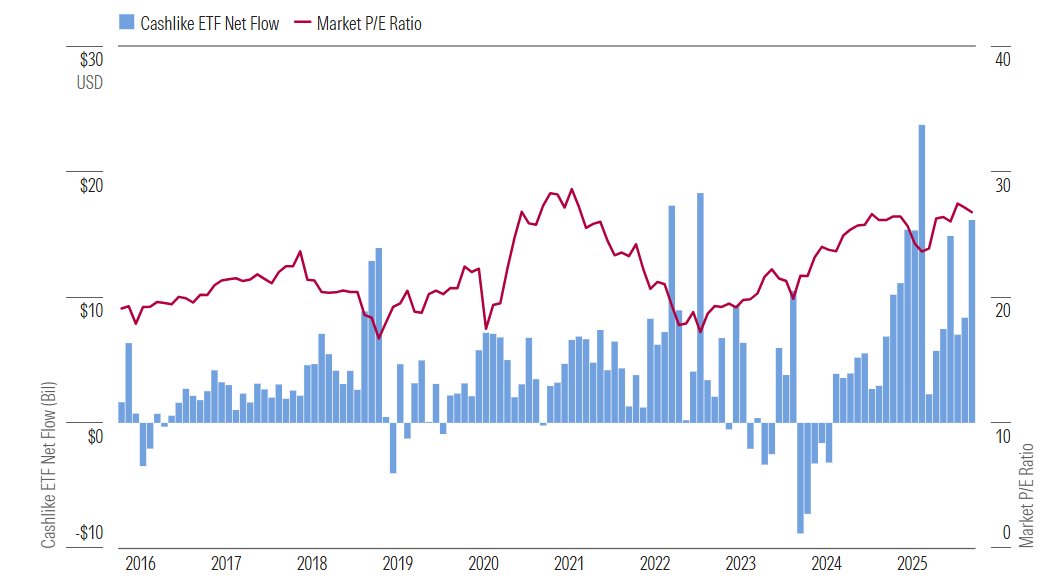
Source: Morningstar
The Environment Has Favored Cash-Like ETFs
Cash-like ETFs attract investors for good reason. Historically, cash allocations shrank during market rallies and expanded only in crises. Today’s inflows signal a structural rethinking of liquidity. Investors no longer view cash as dead weight; they recognize its potential to generate meaningful income while preserving flexibility.
The secret of these ETFs lies in their holdings.
Many of these ETFs fall under the ultra-short-duration bond category, where they invest in fixed-income securities maturing in 180 days to 1.5 years. These include T-bills, commercial paper, bankers’ acceptances, and repurchase agreements. This duration and credit exposure offer inflation-beating yields with ample liquidity. Actively managed, these funds boost yields while preserving liquidity.
The current environment suits these active cash-like ETFs.
Risk has risen across the board. Geopolitical issues and weak economic data erode investor confidence, especially with equity valuations at historical highs. Many investors thus turn to safer options like cash.
The Federal Reserve’s rate cuts have quickly eroded cash returns through falling bank deposit rates and short-term market yields. Traditional savings and checking accounts lag Treasury bill and ultra-short bond yields. Investors gain extra yield with cash-like or ultra-short ETFs without losing liquidity. These ETFs thus deliver meaningful income in a declining-rate cycle, unlike the ultra-low yields of the 2010s.
Investors recognize that today’s cash yields may remain structurally higher than in the past decade, supporting sustained demand.
How Investors Can Add Cash-Like ETFs to a Portfolio
Going forward, dynamics supporting inflows to cash-like and ultra-short-duration ETFs should persist into the new year. These funds deliver higher yields longer without sacrificing liquidity or raising volatility, positioning them as strategic portfolio allocations.
The active ETF revolution makes adding these funds to portfolios simple. Numerous ETFs now serve cash segmentation strategies, reduce volatility, or boost income in conservative portfolios. Cash remains king; investors just use it differently.
Actively Managed Cash-Like and Ultra-Short-Term Bond ETFs
These active ETFs offer low-cost exposure to cash and cash-like bonds. Sorted by YTD total return (0.40% to 0.90%), they have expense ratios of 0.08% to 0.54%, assets under management from $591M to $36B, and current yields of 3.3% to 4.5%.
| Ticker | Name | AUM | YTD Total Ret (%) | Yield (%) | Exp Ratio | Security Type | Actively Managed? |
|---|---|---|---|---|---|---|---|
| GSST | Goldman Sachs Ultra Short Bond ETF | $1.37B | 0.90% | 3.30% | 0.20% | ETF | Yes |
| JPST | JPMorgan Ultra-Short Income ETF | $36.4B | 0.80% | 4.1% | 0.18% | ETF | Yes |
| MINT | PIMCO Enhanced Short Maturity Active ETF | $14.8B | 0.80% | 4.1% | 0.36% | ETF | Yes |
| LDUR | PIMCO Enhanced Low Duration Active ETF | $1.25B | 0.80% | 4.0% | 0.54% | ETF | Yes |
| PULS | PGIM Ultra Short Bond ETF | $13.8B | 0.50% | 4.5% | 0.15% | ETF | Yes |
| VUSB | Vanguard Ultra-Short Bond ETF | $7.34B | 0.50% | 4.4% | 0.10% | ETF | Yes |
| NEAR | BlackRock Short Duration Bond ETF | $3.96B | 0.50% | 4.2% | 0.25% | ETF | Yes |
| GSY | Invesco Ultra Short Duration ETF | $3.28B | 0.50% | 4.50% | 0.22% | ETF | Yes |
| TBUX | T. Rowe Price Ultra Short-Term Bond ETF | $876M | 0.50% | 4.20% | 0.17% | ETF | Yes |
| ULST | SPDR SSGA Ultra Short Term Bond ETF | $591M | 0.50% | 4.1% | 0.20% | ETF | Yes |
| ICSH | BlackRock Ultra Short-Term Bond ETF | $6.88B | 0.40% | 4.1% | 0.08% | ETF | Yes |
Record inflows into cash-like ETFs signal more than temporary caution: a fundamental reassessment of how investors view liquidity, yield, and risk. High equity valuations, declining bank deposit competitiveness, persistent macro uncertainty, and elevated short-term interest rates create an attractive environment for ultra-short-duration investing.
Bottom Line
Cash-like ETFs offer meaningful income, capital preservation, and tactical flexibility, transforming from simple parking places into core portfolio building blocks.
1 Morningstar (January 2026). 6 ETF Investing Predictions for 2026