Technology remains one of the most important sectors for long-term growth in any portfolio. From cloud computing and semiconductors to artificial intelligence (AI) and cybersecurity, the sector continues to drive innovation, productivity, and corporate earnings. For investors, maintaining exposure to technology is no longer optional—it is foundational.
However, the nature of that exposure has shifted dramatically in recent years. The rise of artificial intelligence (AI) has fueled a surge in a handful of mega-cap stocks.
In some cases, individual companies are now worth several trillion dollars, and collectively, a small group of tech giants accounts for an outsized portion of major indices. This concentration has created a powerful tailwind for passive investors—but it has also introduced new risks. That is where active management comes in and could be an investor’s best weapon in the sector.
The Hidden Risk of AI Concentration
It’s no secret that artificial intelligence (AI) remains a game-changer for the world’s economic systems. Its potential to fundamentally reshape society is enormous, which explains why investors have gone all-in on anything AI.
The problem is they may have grown too enthusiastic—specifically around a few key names within the tech sector. The Magnificent Seven, which includes AI leaders Microsoft, Alphabet, Amazon, Meta Platforms, and NVIDIA, has dominated overall market returns since the pandemic, creating a significant dilemma for major indexes.
Market-cap-weighted indices naturally allocate more capital to the largest companies, so passive strategies have become increasingly concentrated in a handful of mega-cap stocks. A decade ago, the seven largest stocks represented only 14% of the S&P 500; today they account for nearly 33%. Overall, tech stocks now hold their highest concentration levels in major indexes in 50 years.
Passive investors have paid the price of this concentration through rising risks. This chart from asset manager T. Rowe Price examines the three largest passive tech ETFs—the Vanguard Information Technology Index Fund, iShares Global Tech ETF, and the Technology Select Sector SPDR Fund—showing how heavily the top AI names pull on each fund.
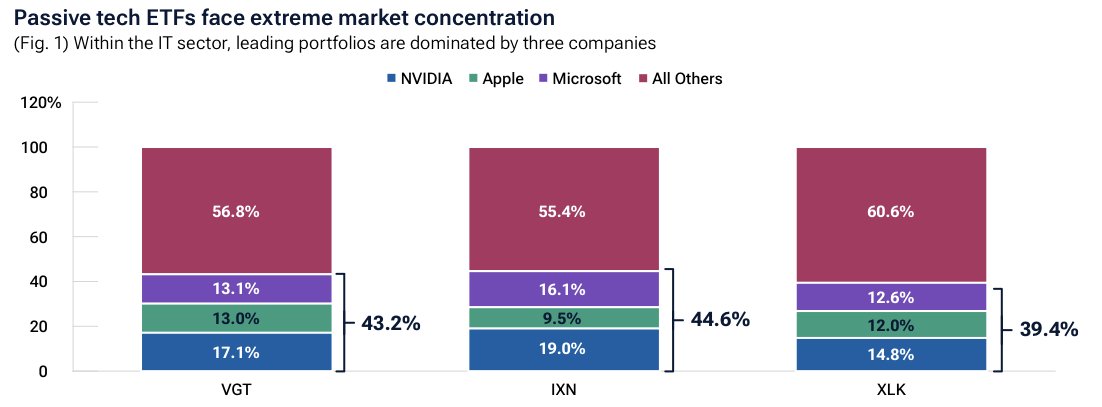
Source: T. Rowe Price
This concentration creates two key risks.
First comes valuation risk. When expectations are high and valuations are elevated, even strong earnings may not be enough to drive further stock gains. Any disappointment—whether in growth rates, margins, or future guidance—can trigger outsized price reactions.
Second, there is an opportunity cost. By focusing heavily on the largest companies, investors may be missing opportunities elsewhere in the technology ecosystem. The AI boom is not limited to a few headline names—it is creating ripple effects across multiple industries and subsectors.
Yet these opportunities are often underrepresented in passive indices.
Why Active Management Can Add Value in Tech
While mega-cap AI leaders dominate headlines, the technology sector is far broader and more dynamic than it may appear. Numerous areas are experiencing strong growth with far less attention, but identifying these opportunities requires deep research, forward-looking analysis, and a willingness to deviate from index weights—all hallmarks of active management.
The technology sector is one of the few areas where active management has historically demonstrated the potential to add value.
Active managers can analyze business models, assess competitive positioning, and evaluate long-term growth potential in ways passive strategies cannot. They can identify companies gaining share, improving margins, or benefiting from emerging trends, while avoiding those that may be overvalued or facing structural challenges.
Importantly, active managers are not constrained by index composition. They can underweight or avoid overvalued mega-cap stocks, allocate more capital to underappreciated opportunities, and adjust exposures as market conditions change—flexibility that is particularly valuable in a sector where leadership can shift quickly.
This allows managers to balance growth potential with risk management. While mega-cap AI leaders are likely to remain important, their dominance creates concentration risk. Active managers can mitigate this by diversifying across a broader set of opportunities, reducing reliance on a single theme or group of stocks.
Building a Smarter Tech Allocation
Given growing concentration risks and missed opportunities, investors may want to add active management and active ETFs to their tech portfolios. Incorporating active management into technology exposure can take several forms.
One approach is to use active ETFs as a core or complementary allocation, providing diversified exposure to a curated set of technology companies.
Active Tech ETFs
These ETFs provide low-cost tech and AI exposure. Sorted by YTD total return (5.7% to 45.2%), they carry expenses of 0.18% to 0.77% and AUM ranging from $31M to $8.8B, with yields between 0% and 2.5%.
| Ticker | Name | AUM | YTD Total Ret (%) | Yield (%) | Exp Ratio | Security Type | Actively Managed? |
|---|---|---|---|---|---|---|---|
| BAI | iShares A.I. Innovation and Tech Active ETF | $8.8B | 45.2% | 2.5% | 0.65% | ETF | Yes |
| ARTY | iShares Future AI and Tech ETF | $788M | 43.9% | 0% | 0.47% | ETF | Yes |
| TEK | iShares Technology Opportunities Active ETF | $31.46M | 32.4% | 2.4% | 0.77% | ETF | Yes |
| TTEQ | T. Rowe Price Technology ETF | $138.29M | 27.9% | 0% | 0.63% | ETF | Yes |
| BCTK | Baron Technology ETF | $146M | 16.8% | 0% | 0.75% | ETF | Yes |
| IETC | iShares U.S. Tech Independence Focused ETF | $750.48M | 5.7% | 0.3% | 0.18% | ETF | Yes |
The technology sector remains one of the most compelling areas for long-term investment, though it is growing more complex and concentrated.
The dominance of a handful of mega-cap stocks has created both opportunity and risk. Their elevated valuations and heavy index weights make future returns less certain, yet a wide range of opportunities exists beneath the surface—across smaller companies, emerging technologies, and underrepresented subsectors.
Active management offers a way to access these opportunities, providing the flexibility, insight, and selectivity needed to navigate a rapidly evolving landscape.
Bottom Line
In today’s technology market, where a handful of mega-cap AI names dominate headlines, index weights, and investor attention, active management offers a compelling way to uncover opportunities beyond the obvious.